


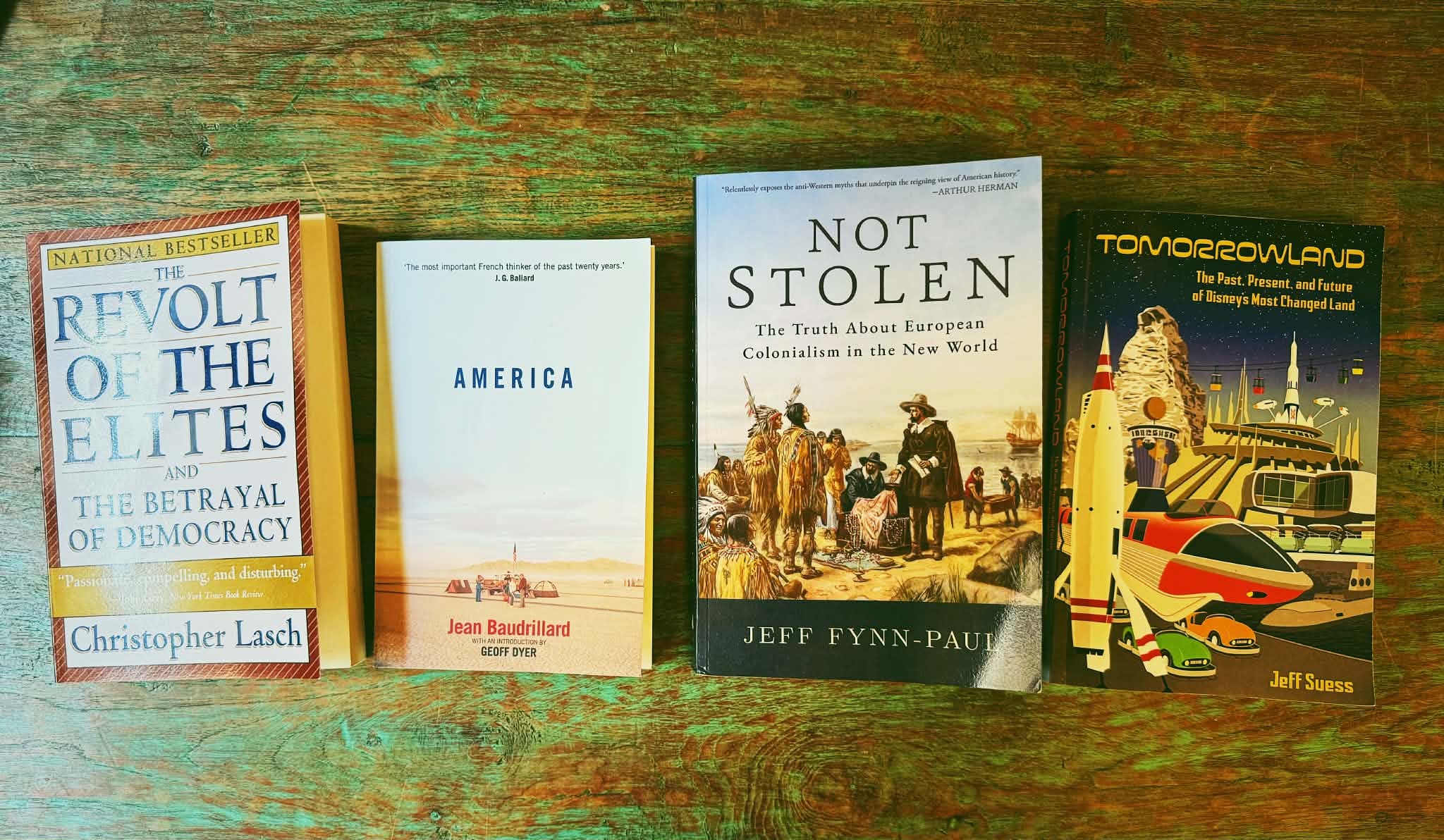
I read five books in January. One of them has been redacted from this list (for reasons that will become clear in the future) so here are reviews of the other four - plus a round-up of some of the best essays I read this month:
The Revolt of the Elites and the Betrayal of Democracy
by Christopher Lasch (1994)
Lasch argues that America’s political class has revolted from the nation itself. Over the decades, as elites became more mobile, credentialed, and globally oriented, they stopped depending on local communities and national solidarity. The American people stopped being seen as fellow citizens to represent and serve, but a threatening population who might want the wrong thing and therefore must be managed, placated, and even undermined.
Lasch charts the historical currents that led to the revolt of the elites - from changes in higher education and credentialism, to managerialism and globalization, to the therapeutic turn in politics and the collapse of a shared narrative – to give us the present moment, where America’s managerial classes have formed a globalized caste that is more loyal to the international marketplace than to the “parochial” concerns of their fellow citizens.
The culture wars that have convulsed America since the sixties are best understood as a form of class warfare, in which an enlightened elite (as it thinks of itself) seeks not so much to impose its values on the majority (a majority perceived as incorrigibly racist, sexist, provincial, and xenophobic), much less to persuade the majority by means of rational public debate, as to create parallel or “alternative” institutions in which it will no longer be necessary to confront the unenlightened at all. (pg. 21)
America
by Jean Baudrillard (1986)
French theorist Jean Baudrillard’s travels across America in the ‘80s formed the basis for America. The prose is exhilarating. It would be easy to call it hypnagogic, as it often feels like something half-dreamed drifting up from the subconscious, but that implies a descent, something inchoate and murky, when actually Baudrillard writes from a stratospheric vantage point. America is not a street-level ethnography nor a history. Instead, it chronicles “astral” America, the nation as projection, as simulation, and the book itself feels astral – soaring over deserts, freeways, cities, engaging not directly with social reality but with America as an idea that has escaped gravity.
For Baudrillard, America is nation where the real is built out of ideas, where paradox dominates, and there is no claim to being extraordinary - there is simply being extraordinary. Even American banality, Baudrillard writes, is a thousand times more interesting than the European variety. But he is not praising or even critiquing America, rather diagnosing it as hyperreal, simulated, and indifferent to depth. Baudrillard studies what America emits: its radiance, its speed, its emptiness, its dazzling self-evidence and finds America to be the last remaining primitive society - and modernity itself.
In America, space lends a sense of grandeur even to the insipidity of the suburbs and “funky towns.” The desert is everywhere, preserving insignificance. A desert where the miracle of the car, of ice and whisky is daily reenacted: a marvel of easy living mixed with the fatality of the desert. A miracle of obscenity that is genuinely American: a miracle of total availability, of the transparency of all functions in space, though this latter nonetheless remains unfathomable in its vastness and can only be exorcised by speed. (pg. 8)
Not Stolen: The Truth About European Colonialism in the New World
by Jeff Fynn-Paul (2023)
Not Stolen debunks the distortions that have become commonplace regarding the European conquest of the new world. I am old enough to have gotten a somewhat balanced education on the matter, so I was aware that contemporary narratives are skewed, but reading this was still a shock because it shows just how far we’ve gotten away from even a semblance of historical truth. Not Stolen is a straightforward read that attempts to re-balance the contemporary narrative, by presenting points like:
America is not stolen and the idea that any of these lands belonged to any native group permanently is a Eurocentric fiction that ignores the ubiquity of inter-tribal violence and conquest. American Indian history prior to European contact is a long account of conquest, slavery, war, and even human sacrifice. By putting a stop to this European settlers arguably saved more lives than they purposefully took. Everywhere in the new world that had a large population of indigenous people prior to European contact continues to have a large population of indigenous people to this day.
For much of the 500 years since Columbus, 90% of North America belonged to the American Indians. Today, tribally registered native Americans possess more land per capita than Americans of any other background, amounting to over 2% of the US property market at a value of about $700 billion.
European settlement did not include genocide – the US native population has remained proportional to the overall US population for centuries. Less than 1% of American Indians were killed by direct acts of violence by settlers – far more Europeans were massacred by American Indians than the reverse. And far more American Indians were massacred by other American Indians.
European colonists were not uniformly “racist,” in fact, centuries before the rest of the world, many settlers undertook to ally with, care for, and make laws to protect the Indians. Few other civilizations in history ever had such constant public debate over how to properly relate to another. Since the 1600s American churches and charitable groups provided food, clothing, shelter, education, and legal representation to native people. European settlers worked to inoculate American Indians against disease as soon as a vaccine was available – many American Indians were inoculated against smallpox before white people in the same region.
American Indians were the first group to receive federal welfare, decades before any other. Today the federal budget allocated to American Indians is more than $20 billion per year, equivalent to about $20,000 per person.
American history contains violence and brutality, which Fynn-Paul does not deny. Rather, his argument is that to take only the negative and insist that was the totality of the story is to present a purposefully unbalanced view of history in service of a contemporary ideological agenda.
Looking at global history as a whole, it is abundantly clear that Europeans were no more prone to violence, hierarchy, patriarchy, or slavery than any other people on Earth. In fact, the last few centuries have demonstrated nearly the opposite: Western civilization has been the overwhelming force behind the triumph of human rights in modern global society… This human rights revolution was made possible through the advance of European learning and technology – the same learning and technology that are lamented so bitterly by those who criticize European expansionism and colonization. In a further irony, the theoretical framework that paints Europe as so particularly depraved is itself a brainchild of the European tradition of scientific and Enlightened self-criticism. Only in the West has radical self-criticism evolved to the fine heights we see today. (pg. 378)
Tomorrowland: The Past, Present, and Future of Disney’s Most Changed Land
by Jeff Seuss (2025)
Tomorrowland is a meticulously researched history of Disney’s futuristic theme park, a space that over the decades has showcased science, technology, and visions of what life might become – often in partnership with real scientists, engineers, and even astronauts. This book delves into the granular details of the park’s conception and execution, going through each of the rides and exhibits over its history, to trace the changing philosophies and visions of the future it showcased. Tomorrowland, the park, functions as both a cultural artifact and a living experiment that combines a deep nostalgia for an idealized American past with a boundless optimism for America’s future – a future that the park shaped by influencing the American imagination. Rather than treating the park as kitsch or mere corporate spectacle, this book takes its ideas seriously, revealing Tomorrowland as a sincere expression of mid-century faith in progress, imagination, and national purpose.
Walt Disney was a visionary. He imagined what the world could be, a place of progress, innovation, cooperation, and a better tomorrow, and he did what he could to make it happen. That may come as a surprise to people who think of him as only the kindly Uncle Walt who introduced Walt Disney’s Wonderful World of Color every Sunday night. Or as a conservative 1950s media mogul, out of touch with today. Or just a statue holding hands with Mickey Mouse at Disneyland’s Plaza Hub. Walt’s vision for the future was as much a part of his character and his impact on the world as was his treasuring of the past. (pg. 1)
And now some of the essays I read in January:
The Metaphysics of Walmart: An American Liturgy of Aisles and Appetite
by Javier Velazquez
“Walking into a Walmart is not like walking into just any store. It is like stepping under a false sky. The fluorescent warehouse is entered and perceived with a kind of impersonal eternity, an artificial firmament, flat and without mercy—and beneath it the world is re-sorted into aisles of calculable appetite. Here are the calories densified, sweetened, made immortal in packaged plastic. Here are the objects that pretend to be goods. Here are the plastic toys that are not really toys, the polyester clothes that are not really clothes, the cheap furniture that is not really furniture—just shadows of things, false versions mass-produced. The modern miracle of Wal-Mart is not abundance, it is the ability to make abundance feel like poverty.”
Do Defenders of Sanctuary Cities Know How They Actually Work?
by David Dennison
“Point being, sanctuary laws not only aren’t required to prevent what they aim to prevent, they do quite a bit of harm. They go out of their way to place people who do not belong in the United States - people who have sometimes done terrible things in the United States - out of the reach of the agency tasked with removing them from the United States… If people want to defend these practices anyway, they should. But they should be encouraged to do it based on their actual outcomes, not just their imagined ones.”
The long, long 2010s: How We Got Here
by Phoebe Maltz Bowy
“From 2008 to 2021 (it’s never an exact decade, this is one thing and maybe the only thing I retained from grad school), things were very much a certain way. They aren’t that way now except in the historical reenactment zone called Bluesky and possibly in certain corners of Canada. And they weren’t that way in the pre-2008 2000s, an era I associate with going-out tops and The Hills although I’m sure other things happened. (9/11 comes to mind, but that was the moment that marked the end of the 1990s.)”
explaining immigration in one graph: what worked, what went wrong, and how to fix it
by El Gato Malo
“immigration on the US once ran a “cream filter.” it was hard to come here and harder still to make it. there was little to no safety net, widespread discrimination, and hard times. but many came and thrived and assimilated and become americans in every meaningful sense. this was the melting pot, the immigration that worked. it may not have always been nice, but the fact that it was hard was the selector that made it so successful.
but then some bright light said “hey, these folks are grand, we should make it easier to come and help them once they get here!”
and that broke the selector. and problems started.”
Nations Are Real: On the Nominalist Error of Propositional Nationhood
by At All Costs
"A healthy rebalancing among Christians would involve the recognition of nations as real entities, uniting members on the basis of factors such as common descent, language, geography, history, and religion. One need not become a ‘blood and soil’ essentialist, and many will be nervous to acknowledge the real existence of nations out of fear that a renewed sense of nation-realism could lead to excessive efforts to preserve national identity.
As Christians, however, we must not let these fears cloud our thinking. We can, and should, acknowledge the existence of nations as complex bodies of humans, and reason carefully and truthfully about these implications.”
Crashout Politics: Chaos, Delusion, and Feminism
by Librarian of Celaeno
“But what is more interesting to me than the specifics of this particular death are the circumstances surrounding it, the thought-world of the leftist agitators who seem so willing to risk their lives and safety to prevent the police from arresting criminals. It’s not surprising that a woman died, nor that the reaction was so strongly gender-coded. The anti-ICE protests have a strongly feminine character to them, and the widespread support for violence among liberal woman is manifestly the driving force behind them.
The feminist can only conceive of men as being consumed with an urge to control them, because they themselves long to control others, and can imagine no other dynamic. The patriarch is a figure of both loathing and longing, something to be destroyed, but also to become. Violence is seen as the defining feature of manhood, which is to be feared, but also neutralized on the part of men and appropriated by women. The animating principle of feminism politically is therefore to remove the male capacity for violent action from individual men and sublimate it into institutions where authority is diffused such that accountability becomes impossible, yet feminist control is absolute.”